

Get ready for attic insulation with a clear access route, completed prerequisite work, household arrangements and the installer’s project-specific instructions.

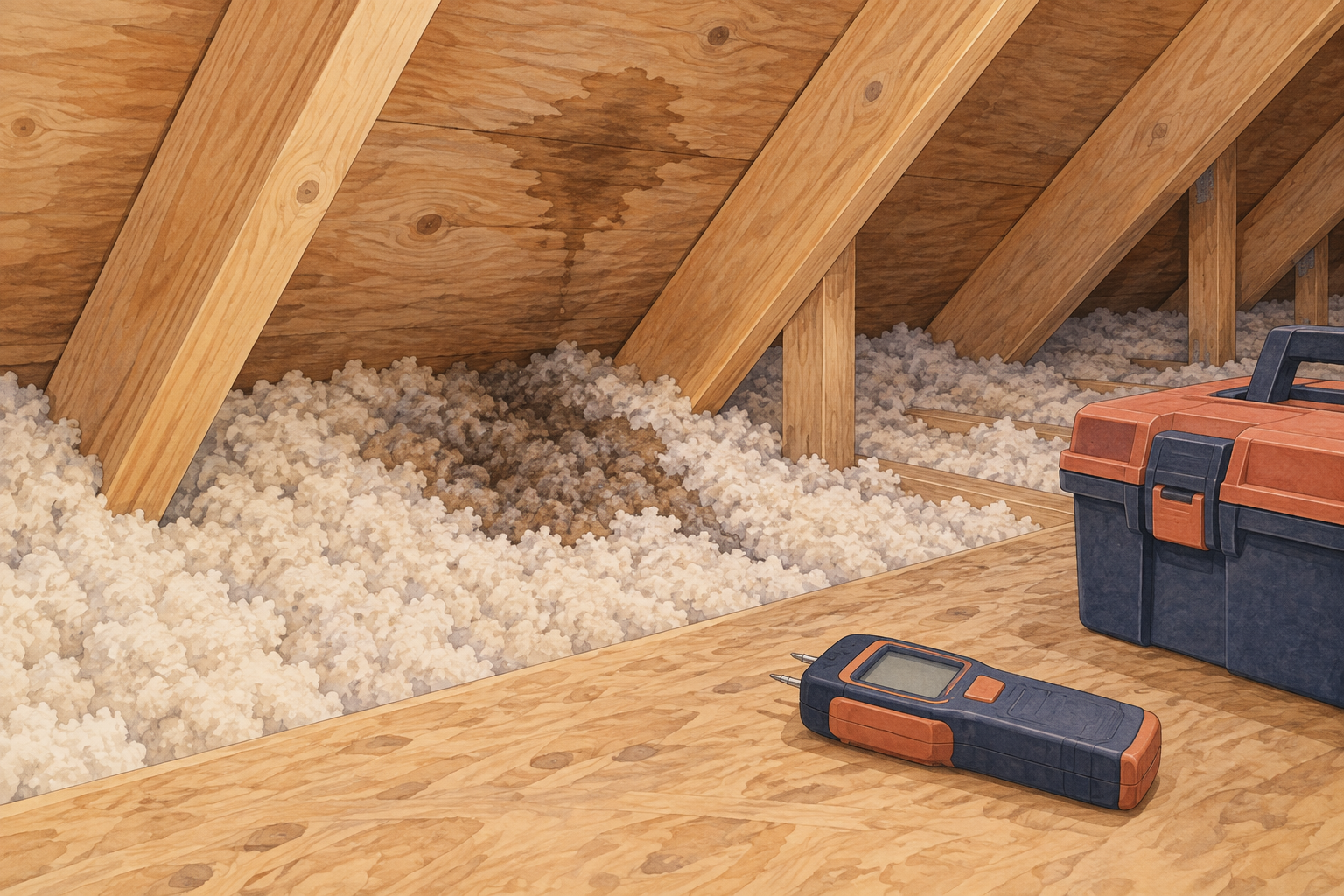
If a roof leak has wet your attic insulation, stop the water source and have the affected area assessed before adding insulation. New material should not cover an unresolved leak or conceal damage that still needs attention.
A ceiling stain can show you where water became visible, but it does not tell you the full extent of attic damage. Avoid walking into an unfamiliar attic to trace the leak yourself. Tell the roofer or other appropriate professional what you observed and when it began.
Begin by identifying who will repair the source of the water and who will assess the affected building materials. The insulation proposal should follow that assessment, with a clear description of the area and material to be removed or replaced.
The EPA’s mold cleanup guidance stresses correcting moisture problems and notes that moldy porous materials may need to be discarded. Visible growth, persistent odors or uncertainty about contamination call for appropriate professional assessment. An insulation estimate is not a mold diagnosis or a remediation clearance.
Do not assume either a small patch or a complete removal is necessary based only on the stain below. Ask the person assessing the attic to explain the affected area, the condition of adjoining insulation and any limits on what could be inspected.
A useful removal scope identifies what will be removed, what can remain and what needs further evaluation. If the condition is different once work begins, agree on how additional work will be documented and approved before the scope expands.
This is a coordination checklist, not a promise that one contractor performs every step. Put responsibility for each step in writing so the insulation appointment does not arrive before the preceding work is complete.
Share the property address, when the leak occurred, whether it has been repaired and any assessment or repair documentation you already have. Existing photos can help explain the concern; there is no need to enter the attic to obtain more.
Time provides insulation vacuum removal and residential insulation. Contact us to discuss the insulation portion of the work, including any conditions that need to be resolved first. If you are also considering an upgrade, keep the damage-related replacement scope separate from the optional improvement.



Get ready for attic insulation with a clear access route, completed prerequisite work, household arrangements and the installer’s project-specific instructions.

Before spray-foam work, get clear answers about the product, work area, ventilation, people and pets, and when the building can be reoccupied.
Ready to cool your home down?
Tell us what you’re dealing with and we’ll recommend the right solution—attic insulation, spray foam, new construction, or insulation removal.

Copyright © Time Insulation | Web Design & SEO by: Blazon Studio


