

Get ready for attic insulation with a clear access route, completed prerequisite work, household arrangements and the installer’s project-specific instructions.

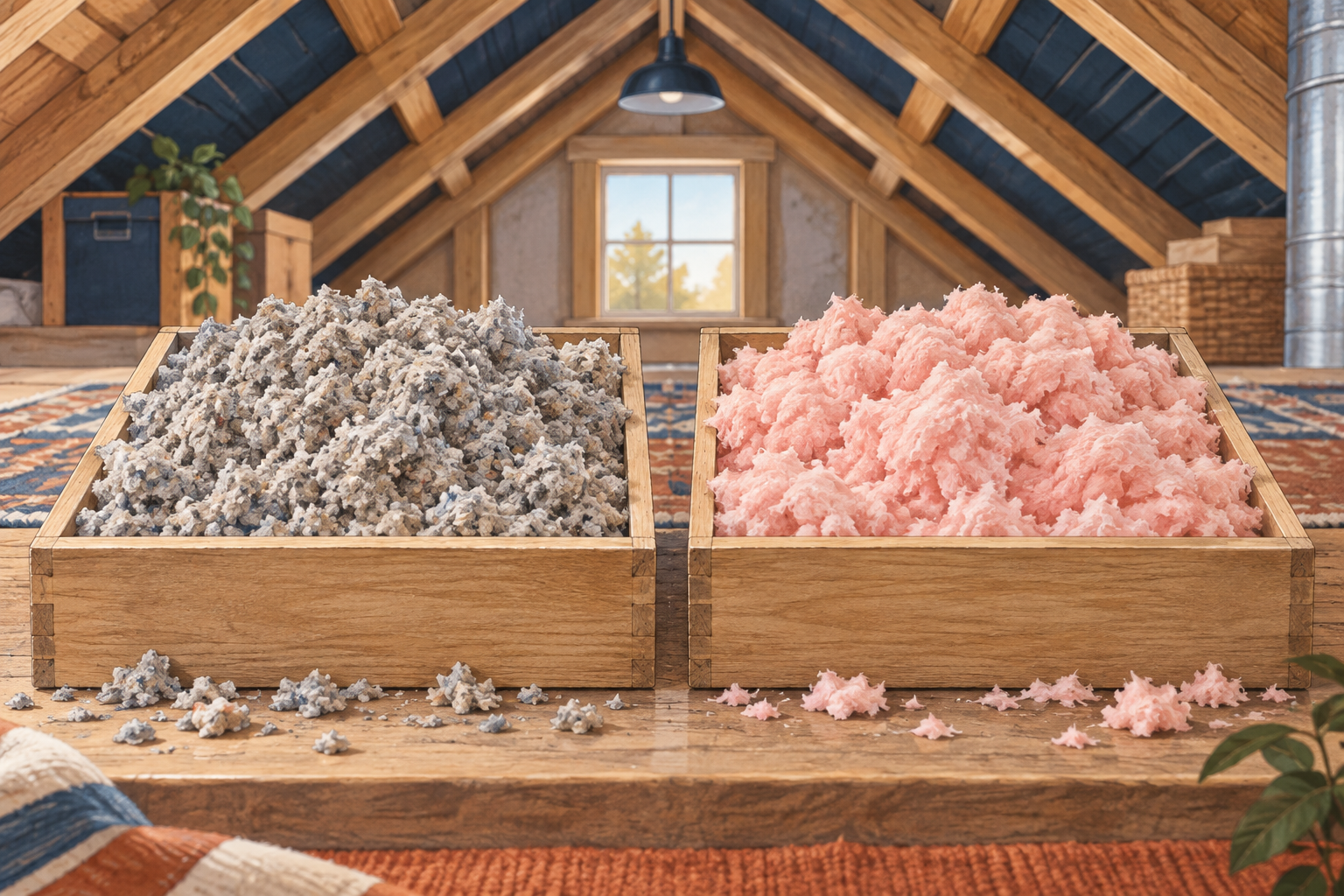
Blown cellulose and blown fiberglass are both options for insulating the floor of an existing vented attic. The useful comparison is the proposed installed R-value, coverage and suitability for your attic—not the material name alone.
Time Insulation offers both blown cellulose and blown fiberglass. Before choosing, make sure the estimates describe the same area and preparation work.
This guide compares loose-fill material blown onto an attic floor. It does not compare fiberglass batts with loose fill or an attic-floor installation with spray foam at the roof deck. Those choices change the installation approach.
The Department of Energy identifies blown cellulose and blown fiberglass as options at the ceiling plane of a vented attic. Its installation guidance also addresses even coverage, air sealing and protecting ventilation at the eaves. Read the DOE attic installation overview.
Time uses Greenfiber cellulose insulation. Greenfiber currently markets SANCTUARY by Greenfiber and describes that product as made with 85% recycled materials. That gives homeowners a specific recycled-content fact to consider when SANCTUARY is the product in their proposal. Confirm the exact product on your estimate before applying its specifications.
Fiberglass is a different material made from glass fibers. Owens Corning’s ProPink L77 is one named loose-fill fiberglass product to distinguish from batts or other blown-fiberglass products. The product specified for your job determines which data sheet and coverage chart apply.
If recycled content is a deciding factor for you, ask for the proposed product's documented content. If available depth is the constraint, ask the installer to show how that product reaches the intended R-value in the space. Avoid transferring one manufacturer's depth, settling or warranty claim to every product in the same material category.
The FTC explains R-value as a measure of insulation’s resistance to heat flow. Different materials can achieve the same rated R-value at different thicknesses. This is why “more inches” is not enough information to choose between quotes.
If existing insulation is suitable to retain, ask whether the proposal adds to it and how the installer will address uneven areas. If removal is recommended, ask for the reason before deciding between replacement materials.
ENERGY STAR flags wet, moldy, odorous and animal-contaminated insulation as conditions needing attention before an addition. Choosing a new insulation material is not a remedy for an unresolved leak or contamination. See the existing-insulation guidance.
Access also belongs in the conversation. Ask which areas can be insulated as proposed and how restricted sections will be handled. A quote should explain its limits rather than leave you to assume that every part of the attic is included.
Insulation, air sealing and moisture control work together in a home’s enclosure. DOE recommends considering these together when selecting insulation. Read DOE’s overview of insulation selection.
Ask whether the proposal includes air-sealing work and how required ventilation paths will be maintained. Do not treat either loose-fill material as an automatic substitute for those details.
Time generally recommends Greenfiber cellulose for attic upgrades. The final recommendation should still reflect your actual attic: the existing condition, target R-value, access and complete installed price. A specific explanation is more helpful than a blanket claim that one material is best for every Florida home.
If you are mainly concerned about having enough insulation, start with our guide to attic insulation depth and R-value. If you are ready to compare options for your property, request a residential insulation estimate. Tell us where the home is located and what you know about the existing attic insulation so the conversation starts with your project.



Get ready for attic insulation with a clear access route, completed prerequisite work, household arrangements and the installer’s project-specific instructions.

Before spray-foam work, get clear answers about the product, work area, ventilation, people and pets, and when the building can be reoccupied.
Ready to cool your home down?
Tell us what you’re dealing with and we’ll recommend the right solution—attic insulation, spray foam, new construction, or insulation removal.

Copyright © Time Insulation | Web Design & SEO by: Blazon Studio


